Every video you’ve watched ends with a Discord link.
This one ends with a table of contents.
$9–$49
$19–$97
Entry price, once — holds for the next 3 orders.
You already know how this goes. Eleven minutes, a revenue screenshot, a tool the guy is affiliated with, and then the part where it stops: “join the Discord, link in the description.” You have watched step four about forty times now. Nobody has shown you step one — and you are not actually sure whether step one is the model or the account.
So you have forty tabs open, two tools you paid for, maybe a folder of generated images where the face changes between one picture and the next. What you do not have is an order. Not a technique, not a secret prompt — an order. Which thing has to exist before the next thing earns anything.
Almost every stalled account in this business is stalled for one of two reasons, and both of them are a chapter you can read this afternoon.
Most people think they are missing information. They are not. The information is free and it is everywhere. What is missing is the sequence, because the sequence is the part that gets sold — into a Discord, into a $97 month, into a call. That is why the free version always stops at the same place.
This is the five layers of an AI OFM account, written in the order they have to be built, with the cost of each one attached and a chapter listing what was tested and produced nothing. One payment. Nothing to join, nobody to message, no monthly, no upsell call.
And it does not rot. When a model launch or a platform enforcement change makes part of it wrong, the file is corrected and reissued to everyone who bought it — free, for as long as it exists — and buyers get a briefing roughly every two weeks saying what moved and what it invalidates. Paid once, kept current.
SHOW ME WHERE TO START — 4 questions See all four manuals
$9–$49, once. The cheapest paid community in this niche is $50 a month. Prices read 20 Aug 2026.
Before you buy anything: the first sixteen pages, free.
The order the five layers have to be built in, one full month of a real ledger with the 28% that leaves as cost, the five mistakes that cost the most, and an eleven-question audit of the account you already run.
Four manuals and the toolkit.
Same subject, four depths. The sentence under each cover is the one the reader of that tier would have said about their own situation — take the one that sounds like something you have actually thought this month, not the one you would like to be true by December.
Swipe, drag, or use the arrows. Every tier contains the one below it, complete.
-
 STARTER
$9
STARTER
$9$1952% OFF 3 left at this price 84 pages ·15 chaptersI don't know where to start.
SEE WHAT’S INSIDE Buy STARTER — $9 -
 OPERATOR
$19
OPERATOR
$19$3951% OFF 3 left at this price 156 pages ·27 chaptersI post. Nothing turns into money.
SEE WHAT’S INSIDE Buy OPERATOR — $19 -
 SCALE
$39
SCALE
$39$6943% OFF 3 left at this price 264 pages ·46 chaptersI'm at three grand and it took everything I have.
SEE WHAT’S INSIDE Buy SCALE — $39 -
 COMMAND
$49
COMMAND
$49$9749% OFF 3 left at this price 372 pages ·69 chaptersI lost the account. / I have three models and chaos.
SEE WHAT’S INSIDE Buy COMMAND — $49 -
 The Operator Toolkit
$29
The Operator Toolkit
$29$3925% OFF 3 left at this price 12 Claude skills · prompt libraryTwelve Claude skills and the prompt library.
SEE WHAT’S INSIDE Buy The Operator Toolkit — $29


You’re not missing information. You’re missing the order.
There are three ways this business fails, and they are all the same mistake: something got built on top of something that was not holding yet. Every one of them feels like hard work while you are inside it. That is exactly why people stay in them for months.
- Reach without Trusta countdown to a ban
- Revenue without Reacha rounding error
- Factory without Personaexpensive noise
What each one looks like from the inside
Reach without Trust. The posts are landing. The follower count moves every day. What you cannot see is that the account was never warmed up, the files carry the metadata they were generated with, and the link went in the bio on day one. It works right up until it does not, and then it is gone in a single morning — along with whatever balance was sitting in it.
Revenue without Reach. The funnel is built. The pricing is thought through. The chat scripts exist. And it converts a perfectly respectable percentage of eleven people. This is the one that wastes the most months, because everything you are doing is correct and none of it is the constraint.
Factory without Persona. You are generating a face before deciding who she is or which niche she is in — the most common opening mistake in this business, and the one the manual opens on. The face drifts between shoots, the wardrobe does not tell a story, and the credits are already spent. It looks like production. It is inventory nobody asked for.
The five layers, top to bottom
Read it from the top and it is a list of what you want. Read it from the bottom and it is the order you have to build in. Layer 3 is the one that decides whether layers 4 and 5 still exist next month — and it is the layer free material almost never covers, because it is boring and it is where the paywall goes.
- Revenue funnel, chat, whales, the actual unit economics
- Reach traffic, split tests, multi-platform, multi-account
- Trust the layer that decides whether 4 and 5 exist next month
- Factory how the images and the video get made — and what a second of it costs
- Persona who she is, and which niche — decided before the face
Once you have the stack in your head, the diagnosis gets cheap. You stop rewriting captions when the problem is that nothing survives long enough to compound, and you stop buying another generator when the problem is that nobody ever finds the account. Most stalled accounts are stalled for exactly one of two reasons. Both are chapters in here, and one of them is probably yours.
Drag the handle. Left is the week you’re having.
Nobody stalls here because they are lazy or because they picked the wrong generator. They stall because they are working hard at a layer that cannot pay yet — and from the inside, that feels identical to progress. Pull the handle across. Nothing on the right is a promise about money. It is what stops being guesswork.


Drag the handle · or use the arrow keys
Before — and this is most people
- Lost
- forty tabs, no first step
- Burning
- credits out, nothing publishable
- Exposed
- no warm-up, link straight in the bio
- Blind
- something broke, no idea which part
- Grinding
- working harder, at the wrong layer
After — same person, same week
- Oriented
- one file, one first step, in order
- Deliberate
- every generation has a job
- Covered
- warmed up, two accounts, documented
- Diagnostic
- you can name the broken layer
- In control
- you know your own numbers
Read the left column again and notice what it is not. It is not stupid and it is not lazy. It is the exact behaviour you would derive yourself from watching twenty videos, because every video opens at the layer that films well. Nobody makes content about a 7–21 day warm-up. There is nothing to screenshot.
The right column is not a personality transplant either. It is the same person, doing the same hours, with two things they did not have before: the order the layers have to be built in, and a way to tell which one is currently broken. That is the whole difference, and it is why the fix is cheap once you can see it.
Page 2 tells four kinds of people not to buy this.
Not as a hook. The chapter is there because the wrong buyer costs more than the sale is worth — they spend two months and $400 of credits finding out something page 2 would have told them in ninety seconds. So it tells them first, before the money changes hands.
- If you want income you don’t have to run. This is a job with a machine in it. The realistic ask is three to five focused hours a day for the first sixty days, and that filter is harder than the money one.
- If you want zero risk of a ban. The goal in here is survivability, not immunity — two accounts, your own message channel, a documented setup. The forensics chapter in SCALE and COMMAND walks through nine documented account losses, and exactly one of them ends with anything coming back.
- If you’re here for brand deals. 800+ applications produced two offers. That number is in the chapter of things that were tested and returned nothing, and it is one of the more expensive lessons in the file.
- If you want moral cover. It does not tell you this is noble. It tells you what the rules are, where the disclosure requirements sit, and that the conservative version of this earns less and lasts longer. You decide; the manual just refuses to flatter the decision.
If none of those four is you, the only question left is which manual — and that is decided by where you are stuck, not by what you can afford.
$2,780 gross. Here is the rest of that line.
That first number is the one that gets screenshotted. It is real, it is documented, and on its own it is close to useless — because you cannot tell from it whether that was a good month or a month somebody lost money on. Here is the same month with the costs left in, exactly as the unit economics chapter prints it.
- generation, proxy, domain, tools
- − $525
- platform fee, at 20%
- − $556
- left, with your own hours unpaid
- $1,699
The platform fee alone is 20% of gross, and it is the line operators most often forget entirely when they work out whether something is worth doing. Then there is the line that is not in the table at all: a chat operator is a documented $1,650 a month, and adding one to this month takes it from $1,699 to double figures. That is not an argument against hiring — it is why the manual times the hire against growing traffic rather than against how tired you are.
The other documented month in the file, a bigger one, lands in the same place from the other direction: roughly 28% of gross went out as cost, and the largest single line was a person, not a model. Anybody selling you a version of this business where AI replaces the chat cost is selling something.
What a thousand views is actually worth
Reach only means something once you know what it pays. Three documented reference points, same platforms, same formats, an order of magnitude apart: platform view payouts came out at roughly $0.04 per 1,000 — a 40-million-view reel pays about $1,600 — while attention you monetise yourself runs $1–$2 per 1,000. Two operators in completely different businesses, one selling a cheap physical product against the views and one selling conversation to subscribers, land in the same band.
That band is a diagnostic, which is the part nobody hands you for free. An account doing two million views a month and earning $200 does not have a reach problem — at that band it should be near $2,000–$3,000, so the break is in the funnel or the chat, and posting more will not touch it. Run it the other way and a revenue target becomes a view quota you can actually check against your own dashboard.
The chapter nobody makes
There is a whole section of things that were tested and produced nothing. 800+ brand applications produced two usable offers, at $540 each. Wishlists produced zero purchases across every model. A course sold as the model was abandoned; music monetisation returned nothing. None of that is discouraging — it is months you now do not have to spend finding out yourself, which is the actual thing you are buying.
Every number in here says where it came from
Reported means an operator's own account of their own result, unaudited — evidence that something happened once, to someone, and not a benchmark. Observed range means the same figure came back similarly from several operators, which is the closest thing to a working assumption this field offers. Modelled means it was built here from the first two and labelled as such, to be re-run with your own numbers — never a forecast.
Where sources disagreed, the more conservative figure was used. Where an operator's own numbers did not add up, both their total and the arithmetic one are printed. The labels stay on the numbers that make the business look worse, too — a file that only labels its good numbers is not being careful, it is being decorated.
Before you decide, look at the actual pages.
The cheapest objection to anything sold at this price is that it is filler — a prompt, a template, four hundred words of encouragement in a PDF wrapper. Fair. So here are real pages, photographed out of the real files, at the size they print. Drag the strip sideways.
-
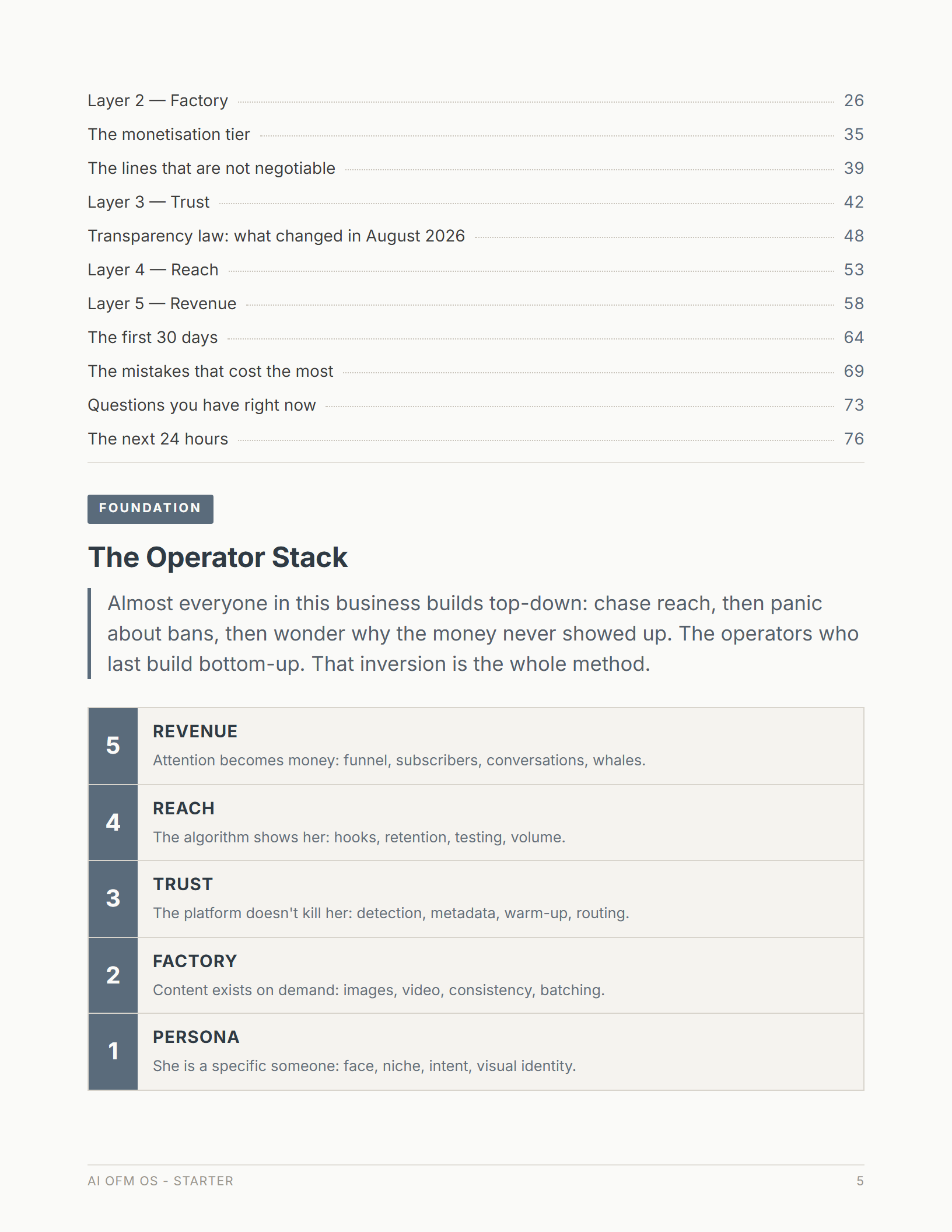
STARTER, page 5 The stack itself. “Almost everyone builds top-down. The operators who last build bottom-up.” -
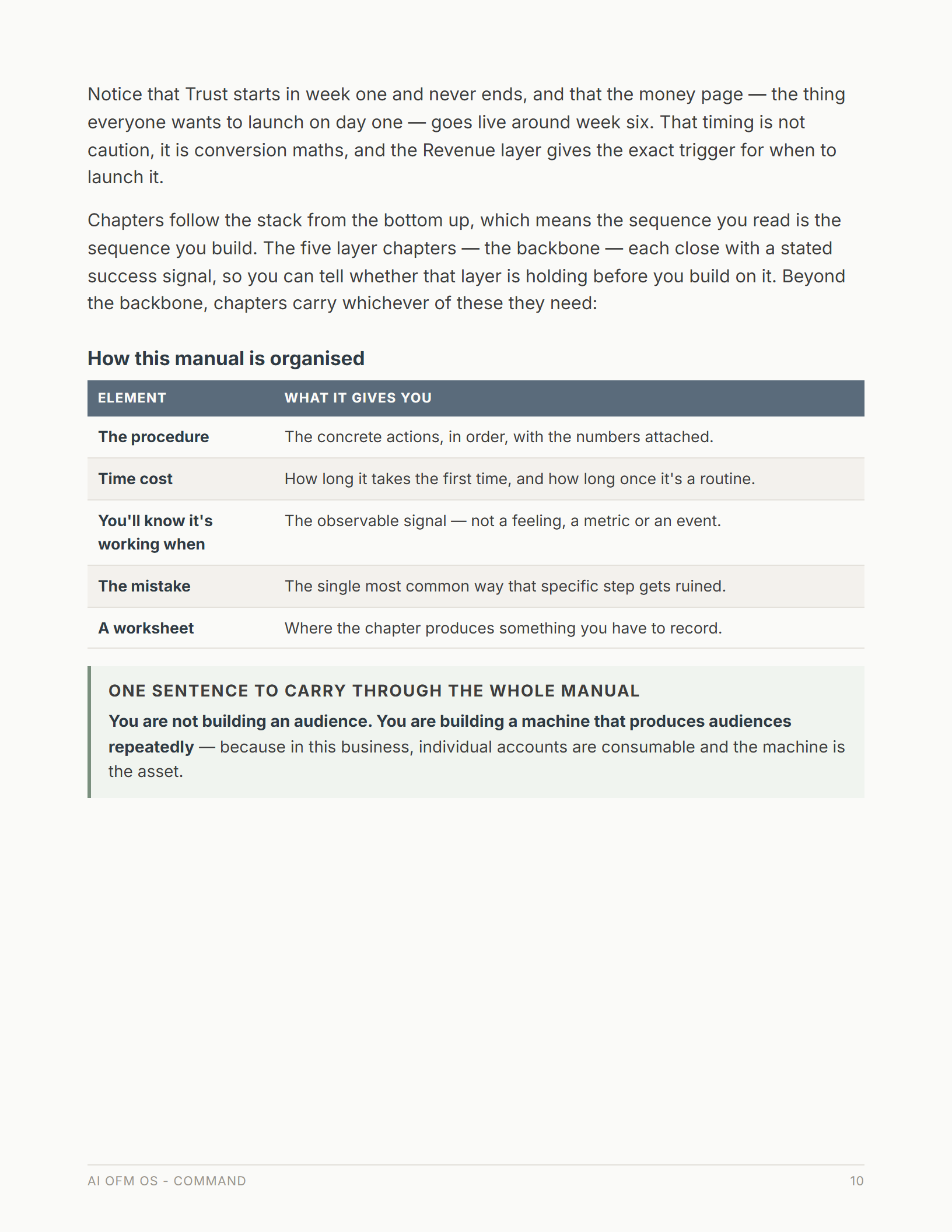
COMMAND, page 10 How every chapter is built: the procedure, the time cost, the observable signal, the mistake, a worksheet. -
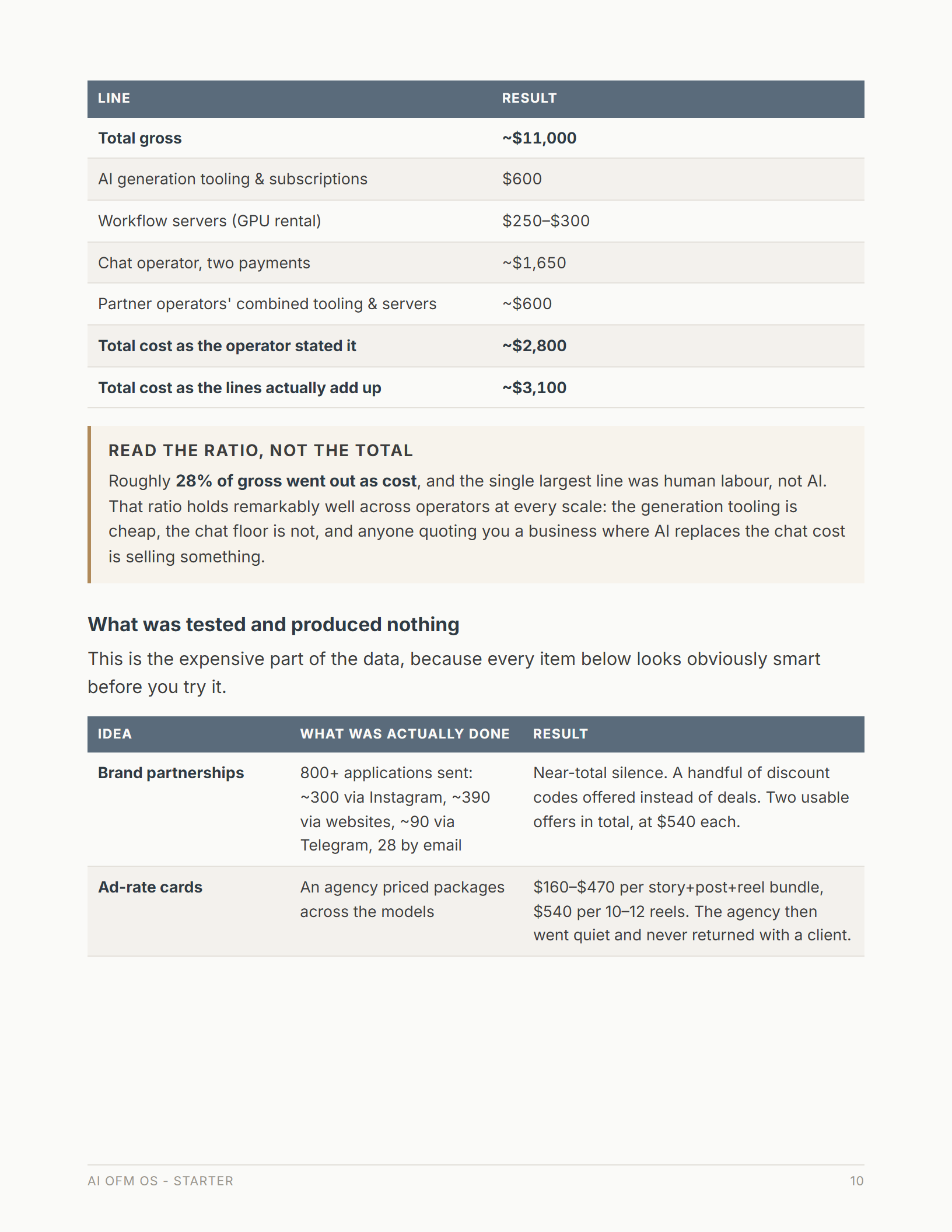
STARTER, page 10 A month with the costs left in, then the list of ideas that were tested and returned nothing. -
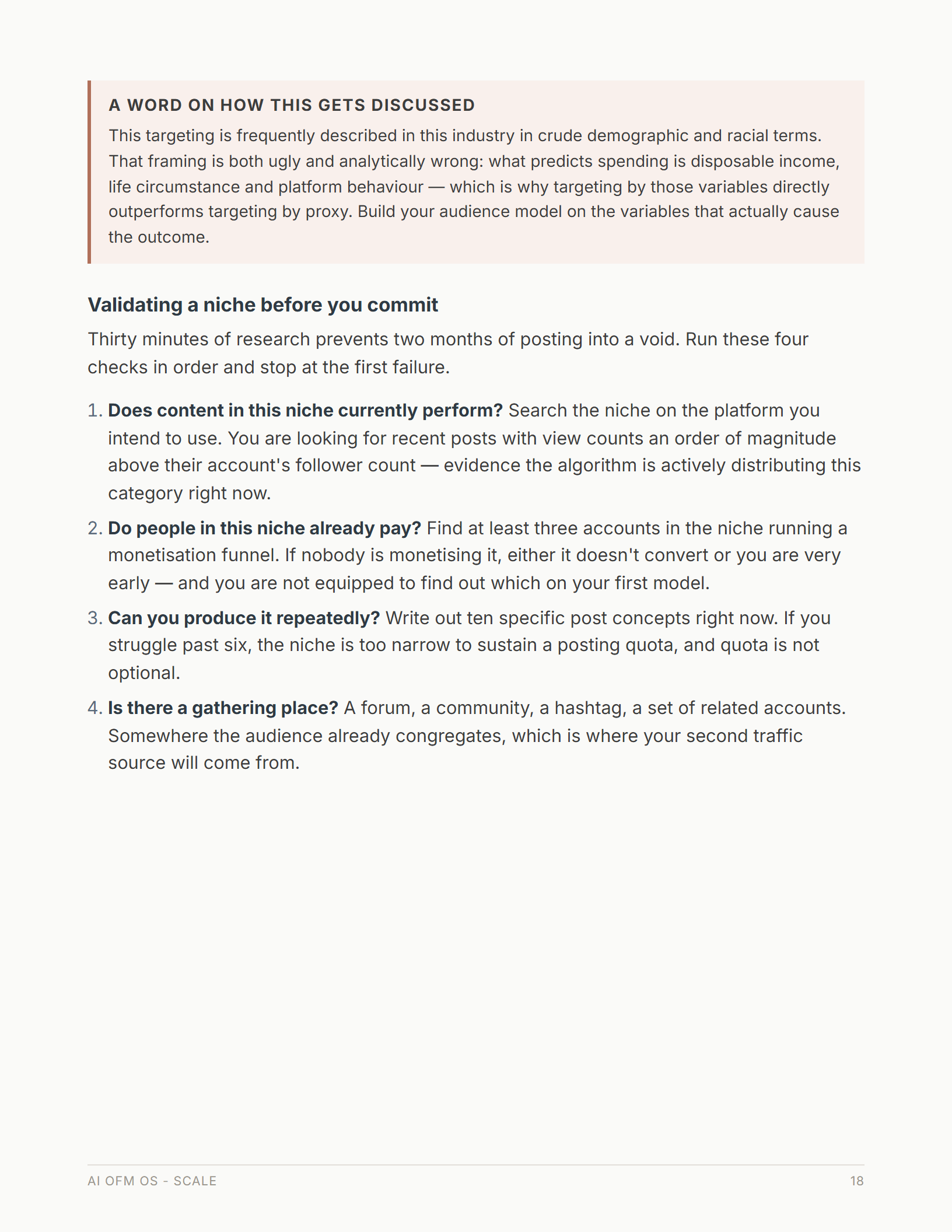
SCALE, page 18 Four checks before you commit to a niche. Run them in order, stop at the first failure. -
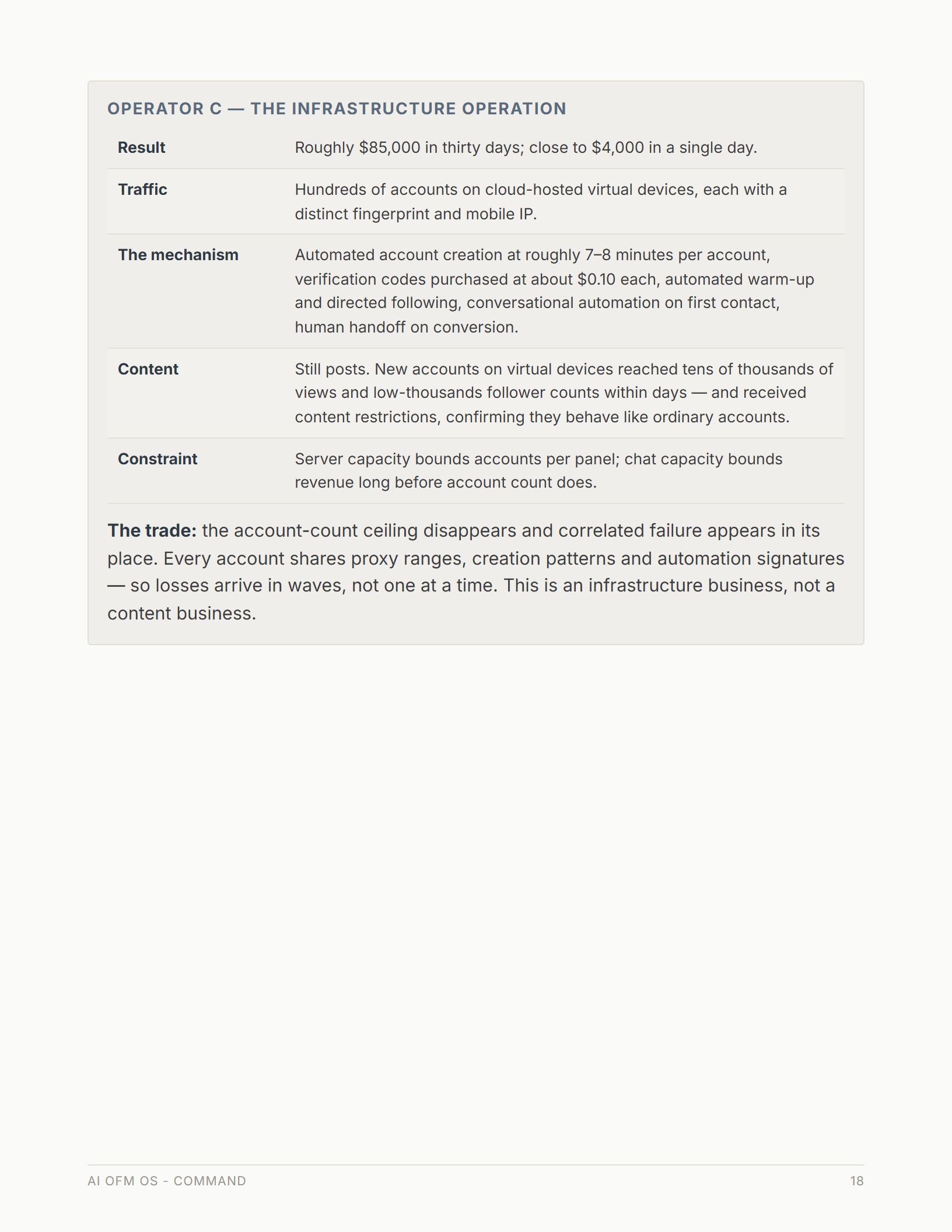
COMMAND, page 18 One of six documented operations: what it earned, the mechanism, and the trade it made — the account ceiling disappears and correlated failure takes its place.
Screenshots, not mock-ups. The page number in the footer of each one is the real page number in the file you would download.
Notice what the pages are made of. Tables with costs in them. A four-step check with a stopping rule. A chapter format that ends every section with the observable signal that it worked, and the single most common way it gets ruined. There is no motivation anywhere in it, and that is deliberate — you are not short of motivation, you are short of a sequence.
Each manual also carries a full table of contents on its own page, so you can read the whole structure before paying for any of it. Nothing about what is inside is a surprise.
What you actually walk away with.
Not a feeling that you are finally going to do it. Five concrete things, all of which are checkable against the table of contents before you pay, and none of which is a number you are promised.
You stop repairing the wrong layer
Revenue drops, so you rewrite the captions — when the real problem is that nothing survives long enough to compound. The stack tells you the order; the diagnostics chapter takes the symptom and hands you the layer.
Chapters: The Operator Stack (every tier), Diagnostics (SCALE and up).
You stop paying to learn what somebody already paid to learn
800+ brand applications produced two offers. Wishlists produced zero purchases. Payout for views landed near $0.04 per 1,000 — against $1–$2 for the same attention monetised yourself, which is the ratio that decides whether reach is even the thing that is broken.
Chapters: The economics nobody screenshots, the mistakes chapter (every tier).
You know what a month costs before you commit to it
Roughly $160–550 in the first month, almost all of it generation credits, and around 28% of gross going out as cost once it runs — with the largest single line being a person, not a model.
Chapters: The first 30 days (every tier), Unit economics (SCALE and up).
You stop overpaying for video by a factor of twenty
The $450-a-day generation figure operators quote is not the price of video — it is 4K, thirty seconds, multi-shot and a large reference set, four decisions short-form does not need. Priced per second, at the settings a reel actually uses, the same nine posts a day are roughly $20.
Chapters: Factory: content on demand (every tier), Video production and its economics (OPERATOR and up).
You get the boring parts that decide whether it lasts
A 7–21 day warm-up before anything operational. File metadata. Two accounts instead of one. Your own message channel. Four weeks at quota before you judge a new account — one documented second account did 15,000 views in its first week and 30 million by day nine.
Chapters: Trust: why the platform lets her live (every tier), the warm-up protocol and ban forensics (SCALE and up).
The honest summary: this makes the failures cheaper and the sequence obvious. It does not make the work optional.
What it will not do is tell you what you are going to make. There is no figure anywhere in these files that is presented as yours, no timeline, and no chapter that says how quickly. Every number says where it came from — an operator's own report, a range several of them repeated, or a model built here for you to substitute your own numbers into. If a page on the internet is willing to tell you what you will earn, it is telling you the one thing it cannot possibly know.
Four manuals. You pick by where you are.
This is one person in four different states, not four different people. Which manual is yours is decided by where the thing is currently stuck — not by budget, not by ambition, and not by how serious you feel about it this week. Read the four sentences below and take the one you would have said out loud.
The first card is not one of the four. It is the free sixteen pages, in case you would rather read something of ours before you decide anything.
I am not paying for a file I have not read a page of.Email it to me — free What is in the free one →
 STARTER
$9
STARTER
$9I don't know where to start.Buy STARTER — $9 See what’s inside →
 OPERATOR
$19
OPERATOR
$19I post. Nothing turns into money.Buy OPERATOR — $19 See what’s inside →
 SCALE
$39
SCALE
$39I'm at three grand and it took everything I have.Buy SCALE — $39 See what’s inside →
 COMMAND
$49
COMMAND
$49I lost the account. / I have three models and chaos.Buy COMMAND — $49 See what’s inside →
Buying sends you straight to checkout — no account, instant download, 14-day refund, free updates for life in the tier you buy. Want the Operator Toolkit with it? Add it on the manual’s own page, where it is discounted against that tier.
The tiers are cumulative, and that is not a pricing trick
Every tier contains the one below it, complete. Nothing is held back from the cheaper file and resold as the expensive one — the split is by how deep you are willing to go, not by how much you paid for the same thing. STARTER is the whole stack once, in order. Each step up goes further into the layers you have actually reached.
Which means the risk of picking wrong is small in one direction and only slightly annoying in the other. Buy too low and you get the correct order and a smaller amount of depth. Buy too high and you have read chapters about a problem you do not have yet — and will have, if it works.
If none of the four sentences sounds exactly like you, the picker asks four questions and lands on one. It asks where you are stuck, not what you hope to make, because a recommendation built on an income wish would just be an income promise with extra steps.
TELL ME WHICH ONE I NEED — 4 questions Compare all four, chapter by chapter
Twelve Claude skills that do the work the manual describes.
A manual tells you what to do. This is the optional half that does it with you: twelve skills that run inside Claude, each one covering a step the chapters describe, plus the prompt library they draw on. Nobody needs it to use the manual — it exists because the gap between reading a procedure and running it is where most people quietly stop.
- /persona
- build the character bible
- /faceset
- build the identity kit
- /shoot
- generate wardrobe, props and locations
- /script
- block the acting performance
- /clip
- write the video prompt
- /feed
- batch a content calendar
- /dm
- build the funnel and chat scripts
- /ship
- QA before publishing
Those eight build the account out of what you decided. Four more work the other way round, from evidence you bring in — someone else’s video, someone else’s captions, your own numbers off a dashboard:
- /teardown
- take apart a piece that performed
- /radar
- read what the niche is doing this week
- /checkup
- find the layer that stopped holding
- /voice
- learn the register the niche writes in
Plus the prompt library, each prompt dated and tied to the chapter it belongs to — including the reference-and-timeline prompt for the current class of video model, the one that generates sound in the same pass as the picture. Two deliveries in the same download: a ZIP that installs into Claude Code, and a copy-paste manual if you do not use it — the second one works in any chat window, so the toolkit is not a reason to go and buy a subscription.
/persona refuses to run until you have named who pays and what
hurts. That is the same rule the manual opens with — generating a face
before deciding who she is is named there as the most common opening mistake
in the business. The toolkit just will not let you skip it —
which is most of the value, and also the thing people find irritating about
it on day one.
What it costs depends on what it is sitting next to
On its own the toolkit is $29. Added to a manual, it gets cheaper the deeper the manual goes — because the further along you are, the more of it you will actually run. Here is the entire matrix, with nothing hidden until checkout:
| with | toolkit | total |
|---|---|---|
| on its own | $29 | $29 |
| + STARTER | $24 | $33 |
| + OPERATOR | $19 | $38 |
| + SCALE | $11 | $50 |
| + COMMAND | included | $49 |
SCALE plus the toolkit is $50. COMMAND plus the toolkit is $49, and it’s 108 pages longer.
That is not a trap, it is just what the numbers do, and it is written here rather than discovered at checkout. If you were heading for SCALE and you want the toolkit with it, COMMAND costs a dollar less and includes both. If you do not want the toolkit at all, SCALE at $39 stays the cheaper answer and nothing on this page will nag you about it again.
One caveat, stated because it is true: if you have not built anything yet,
the toolkit is early. There is nothing to automate before there is a persona,
and /persona will stop you at that exact point anyway. Buy the
manual, build the first thing, come back for this when it is doing work.

no account · instant download · 14-day refund · free updates for life
There are no reviews on this page.
It launched in August 2026 and has not earned any yet. Every other page in this niche would have invented some by now — a rating out of five, a photograph of somebody called Marcus, a number in brackets. That is a ten-minute job and it is the reason nobody believes any of them.
So here is what there is instead: fifteen documented operator sources in the bibliography, plus the regulation and platform documents every legal statement was checked against rather than repeated from a video. Every number says where it came from, there is a chapter listing what was tested and produced nothing, and there are five real pages further up this page that you can read before deciding. When there are reviews, they will appear here and they will be real ones.
And here’s why it’s cheap.
The struck-through price on each manual is not invented — it is the real price this becomes once the next 3 orders sell. Nothing here has ever sold at a higher price; the crossed number is where it is going, not where it has been. Then: $19 / $39 / $69 / $97.
The reason is unglamorous. The first buyers are worth more than the margin on them, because they are the only way to find out which chapters people actually come back to, which questions arrive in the inbox, and whether the tier split is drawn in the right place. That information does not exist yet, and it cannot be bought any other way.
The order count is real, not a marketing timer — it only moves when someone actually buys, never on a reload. When a batch runs out, the next one opens at the same price, and that repeats until the numbers say it is time to move the price for good. That is the entire mechanism: no countdown clock, no reload trick, just the actual order count.
| what you’d pay instead | price | unit |
|---|---|---|
| cheapest paid community in this niche | $50 | per month |
| typical community | $97–197 | per month |
| one-time courses and “vaults” | $97–500 | once |
| this ladder | $9–49 | once |
Read 20 Aug 2026. Free material exists and some of it is good — it’s layer 4, without layers 1 to 3.
Read that table by the unit column, not the price column. The $50 line is fifty dollars every month, for as long as you want to keep asking questions in the channel; a year of the cheapest one is $600. The whole ladder here is $9 to $49, once, and there is no account to close afterwards because there is no account.
What a subscription buys that this does not is people to ask. That is a real thing and it is worth something to some people. What it does not buy is a sequence — the answers live in threads, in the order they were asked, and they scroll away. You are choosing between a room and a procedure.
The other thing a monthly buys is freshness — and that one is already in this price. When a model launch, an enforcement change or a change in the law makes part of the material wrong, it is corrected and reissued to everyone who bought that tier, free, for as long as the publication exists. Buyers also get the Operator Briefing roughly every two weeks: what moved in the niche, what it invalidates in their copy, what was updated in the file. Paid once, kept current, and still nothing to cancel.
What people ask before buying.
Eleven questions, answered at the length they deserve. Several of the answers are worse for us than the polite version would be — that is on purpose, because the alternative is a refund and somebody who spent two months finding out for themselves.
Is this just AI-generated filler?
Fifteen operator sources, all named in the bibliography, plus the regulation and platform documents the legal chapter was checked against. Figures come in three declared kinds — Reported (one operator's own unaudited account), Observed range (the same figure from several), and Modelled (built here, for you to substitute your own numbers into, never a forecast) — and the labelling holds on the numbers that make the business look worse. There is a chapter listing what was tested and produced nothing, and a ranked post-mortem of the seventeen mistakes that cost the most, eleven of which are Trust-layer or sequencing failures rather than content ones. Generated filler does not contain a list of its own failures.
Isn’t all of this free on YouTube?
Layer 4 is free on YouTube. Layers 1 to 3 are what those videos sell you into a Discord to get. What this costs $9 to $49 for is the order — which layer has to hold before the next one earns anything.
Isn’t this niche saturated?
There are a lot of operators and most of them are bad at it. Almost every mistake in the mistakes chapter is self-inflicted, not structural. Saturation would mean the good spots are taken; what is actually true is that most accounts break in one of three predictable ways.
Won’t I just get banned?
Probably, at some point. The goal in this manual is survivability, not immunity: two accounts, your own message channel, a documented setup, and a 7–21 day warm-up before anything operational. The full ban forensics chapter — nine documented account losses, with what each one cost and what triggered it — starts in SCALE; the Trust layer that prevents most of them is in every tier, STARTER included.
I don’t want to break platform rules.
Then read the FAQ chapter before you buy anything. A conservative version of this exists. It earns less and it lasts longer. That is a real trade-off, not a compromise, and the manual says so in those words.
Is this legal?
There is a chapter on legal and disclosure requirements, current as of August 2026, plus the publisher page with refund terms. It covers labelling, platform policy and where the rules differ by market. It is not legal advice and it says so.
Models change every month. Won’t this be out of date by winter?
The tables name classes of model, not versions, precisely because a book that tells you to use version 2.5 is wrong the week 3.0 ships — and there is a page on how to place the next release into the table yourself. What the Factory chapters actually teach is the arithmetic: price per second against your own failure rate, why the $450-a-day generation figure is 4K, thirty seconds and multi-shot rather than the price of video, and the reference-and-timeline prompt structure the current class of model reads. That structure survives releases; the exact wording does not, and the manual says so in those words. When something does move far enough to matter, the file is corrected and reissued — free, in the tier you bought, for as long as it exists — and the briefing tells you what moved before you find out from a dead prompt.
What exactly do I get, and how?
A PDF, formatted for A4 and readable on a phone — 84 pages at STARTER up to 372 at COMMAND — downloadable the moment the payment clears. No account to create and no drip funnel. If you add the Operator Toolkit you also get a ZIP that installs into Claude Code and a copy-paste version that works in any chat window. Updates to whichever tier you bought are free for life and arrive at the same download link. The one email that keeps coming is the Operator Briefing, roughly every two weeks — what changed in the niche, what it invalidates in your copy, what was updated in the file. One click unsubscribes, and unsubscribing never touches your access or your right to the next revision.
What if I buy the wrong tier?
Because the tiers are cumulative, buying too low costs you depth, not correctness — you still get the whole stack in the right order. If you want to move up afterwards, write to us and you pay the difference, not the full price again. And if it turns out you bought something you genuinely cannot use, the 14-day refund covers it without an interview.
How long does it take, realistically?
The reading is one evening for STARTER and considerably more for COMMAND. The work is not. The manual is honest that the realistic ask is three to five focused hours a day for the first sixty days, that the warm-up period alone is 7 to 21 days before anything operational happens, and that the time filter turns out to be harder than the money one for most people. If you have an hour a week, this is the wrong purchase and page 2 says so.
Do I need Claude, or any subscription, to use this?
Not for the manuals — they are a file, and they assume nothing about your tooling beyond the generation credits any operator in this niche is already paying for. The Operator Toolkit ships in two forms precisely so that it does not become a reason to buy a subscription: the ZIP for people already in Claude Code, and the copy-paste version for everyone else.
PICK MY MANUAL — 4 questions Compare all four instead
Every manual comes with a 14-day refund and free updates for life in the tier you bought. No account needed to buy, and nothing to cancel afterwards.
No income guarantee. Nothing sold here promises that you will earn anything. Most people who attempt this business earn nothing, every figure quoted on this page is somebody else’s historical result rather than a projection of yours, and what you get out of the material depends on your market, your budget, your time and platforms none of us control. Full disclaimer, refunds, privacy.