
COMPANION TO THE AI OFM OPERATING SYSTEM
The Operator Toolkit
Twelve Claude skills and the prompt library.
no account · instant download · 14-day refund · free updates for life
What each skill does.
Eight that build the account
- /persona
- Builds the character bible. Refuses to run until you have named who pays and what hurts — the same rule the manual opens with.
- /faceset
- Builds the identity kit: the reference set that keeps the same face across every later generation.
- /shoot
- Generates wardrobe, props and locations that stay consistent with the persona instead of drifting shot to shot.
- /script
- Blocks the acting performance — what she does in the frame, not just what she looks like.
- /clip
- Writes the video prompt, with the constraints that decide whether a clip is usable or a wasted credit.
- /feed
- Batches a content calendar, so a week of posting is one session instead of seven.
- /dm
- Builds the funnel and the chat scripts — the layer where attention becomes revenue.
- /ship
- QA before publishing. The last gate before something leaves your machine with the wrong metadata on it.
And four that read what is happening outside it
The eight above work from what you decided. These four work from evidence you bring in — someone else’s video, someone else’s captions, your own numbers off a dashboard.
- /teardown
- Takes a piece that performed apart, and ends on the part most teardowns leave out: what will not transfer.
- /radar
- Reads the niche this week against last week — a format only shows up as growing or fading in the comparison. Capped at three things to try.
- /checkup
- Reads your numbers and names the layer that stopped holding, instead of telling you to post better content.
- /voice
- Pulls the register the niche writes in out of samples you paste. It takes the pattern, never the phrases.
Two deliveries, one download.
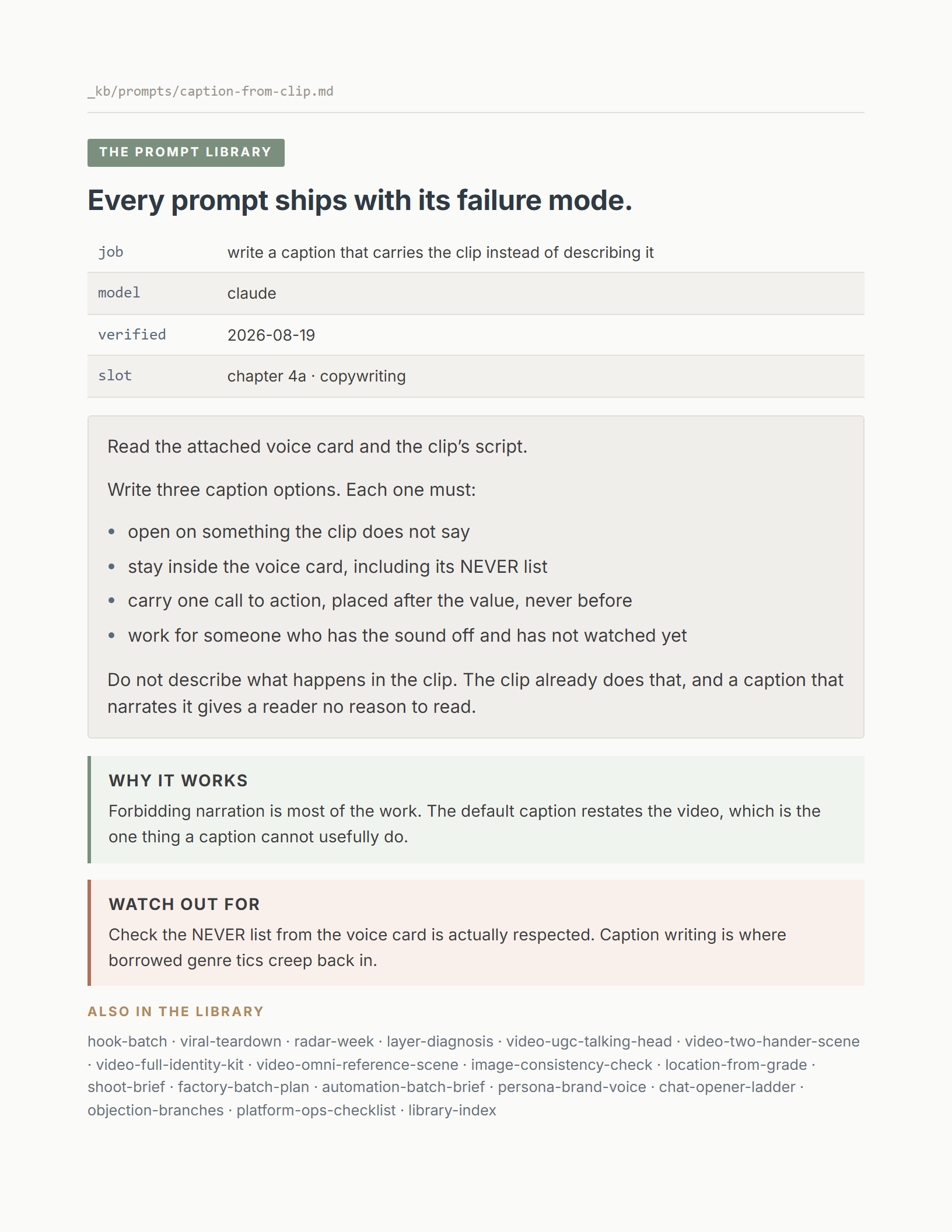
A ZIP for Claude Code, and a copy-paste manual if you don’t use it. The prompt library ships with both — every prompt dated, labelled with the model it was verified against and the chapter it belongs to, so a prompt that has aged out is visible rather than quietly wrong. The video prompts include the reference-and-timeline structure the current class of model reads, sound generated in the same pass as the picture.
What is actually in it.
The skill table, one skill file and one prompt from the library — set in the same type as the manual, because they ship as text you run, not as pages you read.


It gets cheaper with every manual.
| with | toolkit | total |
|---|---|---|
| on its own | $29 | $29 |
| + STARTER | $24 | $33 |
| + OPERATOR | $19 | $38 |
| + SCALE | $11 | $50 |
| + COMMAND | included | $49 |
What it will not do.
It will not decide anything for you. /persona stops on a missing
ICP rather than inventing one. And prompt quality mostly determines how much
you waste on failed generations — it is not the thing that decides
whether the account works. That decision is in the manual.
Delivery.
Instant download after payment, no account needed. 14-day refund. Updates are free for life — new skills, re-verified prompts and corrected model facts come to the same download link, and the Operator Briefing says roughly every two weeks what changed and what aged out.